Research Guide · 5 min read · Updated 2026-08-01
Epitalon Research Guide: The Telomerase-Pathway Tetrapeptide
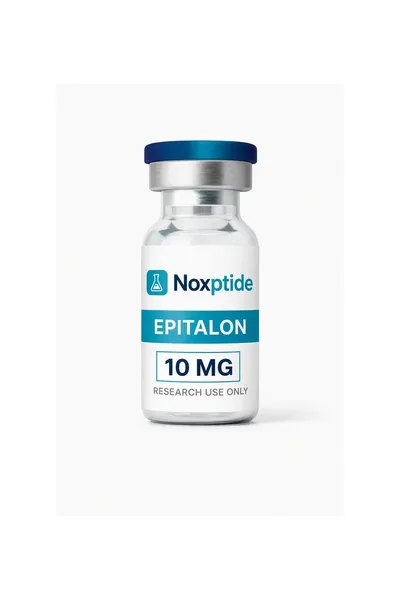
Epitalon (Ala-Glu-Asp-Gly) is a synthetic tetrapeptide based on epithalamin, a peptide preparation from the pineal gland. Small molecule, big literature: it is one of the most discussed compounds in gerontology research, with studies examining telomerase activation and circadian regulation.
What the Research Literature Covers
Published research examines Epitalon in telomerase-activation models, pineal and circadian regulation, and cellular senescence. Much of the foundational work originates from Russian gerontology programmes; PubMed indexes the core studies, and interest from Western laboratories has grown steadily.
Synthetic Tetrapeptide vs Pineal Extract
Epitalon is the defined synthetic tetrapeptide — four amino acids with an exact molecular weight of 390.35 g/mol. It should not be confused with epithalamin, the heterogeneous pineal extract from which it was derived. For reproducible research, the synthetic tetrapeptide is the correct tool: one molecule, one MS signature.
Handling and Storage
Store lyophilised at -20°C; reconstitute with bacteriostatic water and refrigerate at 2–8°C, using within 21 days. As a small tetrapeptide it dissolves quickly with gentle swirling.